Answer first
Most of the smell comes from the fiber. Raw cotton keeps a thin coat of wax, pectin and protein, and sellers put the sweet, earthy note down to cottonseed oil picked up at the gin. The one cotton seller we found that gives a time says the smell fades within about a week, with a few extra days in humid weather (The Futon Shop). A sharp chemical smell usually points to a synthetic fill. A musty smell means moisture, and that is not normal.
This guide is for: people who have just unwrapped a cotton-filled pillow and want to know whether the smell is normal and when it will go.
Key Takeaways
Three points carry most of this page: where the smell comes from, how long sellers say it lasts, and when it means something is wrong.
- Most of the smell is the fiber. Raw cotton carries 0.4 to 1.0% wax along with pectins and proteins. Scouring and bleaching remove most of these and leave nearly 99% cellulose (ScienceDirect Topics). That is why unbleached fill tends to smell more.
- Sellers rarely give a time. We read 7 cotton pillow seller pages on October 22, 2026. Of those, 1 gave a fade time (about a week), 2 described the smell without giving a time, and 4 did not mention a smell at all.
- Musty is a moisture problem. The EPA advises keeping indoor humidity below 60%, ideally 30 to 50%, and drying wet furnishings within 24 to 48 hours to avoid mold (EPA).
Why does a new cotton pillow smell at all?
Cotton fiber carries natural wax and traces of seed oil, and a sealed bag holds their scent in, so the first breath out of the wrapper is strongest.
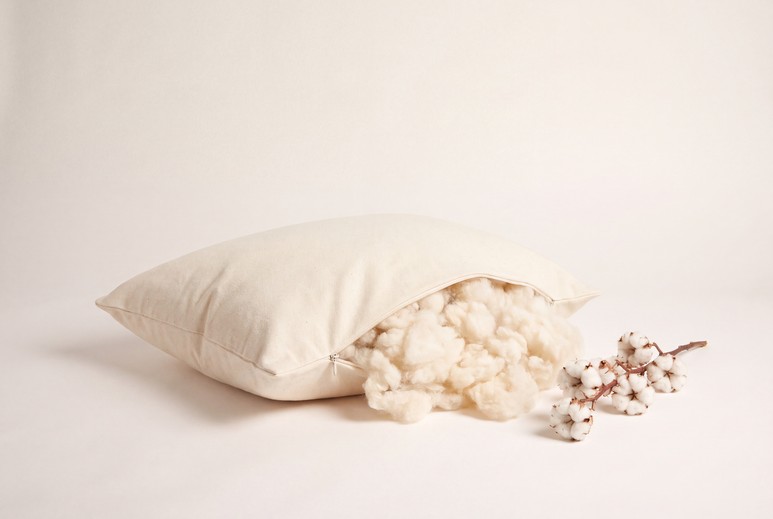
Cotton is a seed hair, and it reaches the pillow maker still carrying traces of the plant it grew on. Cotton Incorporated describes the outer layer of each fiber, the cuticle, as a waxy coat containing pectins and protein. The coat protects the fiber, and scouring removes it (Cotton Incorporated). Besides cellulose, raw cotton holds small amounts of wax, pectin, protein and minerals (ScienceDirect Topics). Most of the scent sits in that thin outer film.
One seller points to a second source. Its FAQ says some people notice a sweet, earthy smell early on, and that most of it comes from oil from the cotton seed, which is present during ginning (A Little Pillow Company).
The bag matters too. The pillow you unwrap may have spent weeks sealed in plastic for shipping, in its own small pocket of air, and whatever the fiber gives off stays in that pocket. When you cut the bag open, you get all of it in one breath. That is why the first minute is the strongest. Once you leave the pillow in open room air, the scent spreads out and thins.
The amount of fiber matters too. A pillow packs far more cotton into one place than a shirt does. A scent you would never notice on a T-shirt is easy to pick up when your face is pressed into it all night.
How long does a new cotton pillow smell take to fade?
Expect days, not hours. The one cotton seller we found giving a figure says about a week, and a few days longer in a humid climate.
One seller of an organic cotton pillow insert says the slight natural odor you may notice on unpacking will dissipate on its own within about a week, and may take a few extra days in a humid climate (The Futon Shop). It was the only cotton-specific figure we found from a seller, so you should treat it as one company's statement rather than a rule.
Most published timelines are written about foam. Tempur-Pedic recommends airing its new pillows for several days before use (Tempur-Pedic). One pillow guide suggests 24 to 72 hours of airing, then says the smell occurs most often with memory foam and latex (Pillows Expert). Those figures describe a different material from the one you bought.
Our reading here is judgement, not measurement. A plain cotton pillow kept out of its bag in a dry, airy room should smell clearly weaker within a few days and close to neutral within a week or two. Humid air slows the fade, because damp fiber holds on to scent. If the smell is as strong after two weeks as on the first day, you are probably dealing with a different problem.
| Situation | Published figure | Source |
|---|---|---|
| Organic cotton insert, ordinary room | About a week | The Futon Shop |
| Same insert, humid climate | A few extra days | The Futon Shop |
| New foam pillow | Several days of airing | Tempur-Pedic |
| Foam or latex, general advice | 24 to 72 hours | Pillows Expert |
| Any furnishing that gets wet | Dry within 24 to 48 hours | EPA |
What do cotton pillow sellers say about the smell?
Most say little. Of seven seller pages we read, one gave a fade time, two described the smell without one, and four did not mention it.
We read seven seller pages for organic or all-cotton pillows on October 22, 2026, and counted what each said about a smell on first opening. We only read and counted what the pages state. We did not handle any pillow. The pages fell into three buckets:
- Gave a fade time: 1 of 7. About a week, plus extra days in humid climates.
- Described the smell, no time: 2 of 7. The smell is called natural and said to fade, with no time given.
- Did not mention a smell: 4 of 7. The text we read covered materials, sizes and care only.
| Seller page | What it says about smell on opening | Bucket |
|---|---|---|
| The Futon Shop | Fades in about a week, longer if humid | Time |
| isleepsimple | Natural cotton scent for a short time | No time |
| A Little Pillow Company | Earthy smell from cottonseed oil, fades over time | No time |
| Vermont Country Store | Materials and care only | None |
| Organic Textiles | Fill, cover and support only | None |
| earthSake | Materials and zipper only | None |
| Sachi Organics | Care steps only | None |
Every page that mentions the smell puts it down to the fiber. Only one gives a time. If you want a firm answer for a particular pillow, you will usually have to ask the seller.
What do the different smells from a new cotton pillow mean?
A sweet, earthy smell is the cotton itself. A sharp chemical note points to the fill or finish, and a musty one points to moisture.
Not every smell comes from the cotton. The table below is our judgement, built from the sources on this page. No lab graded these smells, so use the table to sort out what your nose is telling you.
| What you smell | Most likely source | Normal for new cotton? | What to do |
|---|---|---|---|
| Sweet, earthy, like hay or grain | Wax and seed oil on the fiber | Yes | Air it and expect a slow fade |
| Flat "new fabric" or bag air | A fresh cover and sealed packing | Yes | Air it; wash a removable cover |
| Sharp solvent, glue or plastic | Synthetic fill, foam or a finish | Not from cotton | Check the fill on the label |
| Perfume | Added fragrance | Not from cotton | Ask the seller what was added |
| Damp basement or wet towel | Moisture and mold | No | Dry it fully; return it if it persists |
| Sour or sweaty | Body oils from earlier use | Not on a new pillow | Ask whether it was returned stock |
The useful split is between smells that fade with air and smells that do not. The fiber's own scent and the bag air thin out over days. A synthetic note can linger for as long as the fill is there. A musty smell can get stronger, because whatever causes it is still active inside the pillow. If your pillow has a zipper, smell the cover first and then the fill through the opening. That tells you which part is responsible.
Why does unbleached cotton fill often smell stronger than bleached cotton?
Scouring and bleaching strip the waxy outer layer of each fiber. Fill sold as natural or unbleached keeps more of it, and more of its scent.
During scouring, cotton's natural oils and waxes are converted into soaps, and pectins and plant matter are loosened so they can be washed away (CottonWorks). After scouring and bleaching, Cotton Incorporated describes cotton as almost pure cellulose (Cotton Incorporated). Less wax means less scent.
Fill sold as natural or unbleached skips some or all of that processing. There is a trade-off. A US patent on cotton scouring notes that the softness of cellulosic fabric depends on residual natural cotton waxes (USPTO patent record). The wax that carries the scent also does useful work.
Organic and unbleached are not the same promise. Organic certification is about how the cotton is grown and processed. Many organic pillows are also left unbleached, but the label does not tell you how much wax stayed on the fiber. For what a certificate on a pillow does and does not cover, see whether a GOTS label covers the fill or only the cover. In practice, expect a natural-color pillow to smell more on the first day than a bright white one, and expect both to settle.
Why might a pillow with a cotton cover smell like chemicals or plastic?
A cotton cover can hide a polyester or foam fill. Lab work finds cotton gives off less odor than polyester, so a sharp smell usually sits inside.
A cotton shell does not tell you the fill is cotton. Plenty of pillows sold with an all-cotton cover are filled with polyester fiber. One retailer listing describes a high thread count, all-cotton shell filled with a gel fiber (Wayfair). If the smell is sharp, like solvent, glue or a new shower curtain, look at the fill first.
Lab studies point the same way. One study confirmed low release of volatile compounds from cotton and higher release from polyester (Richter, Laing and Bremer, Textile Research Journal). A later study found that cellulose fibers released smaller amounts of ketone and aldehyde compounds into the air than nylon and polyester did (McQueen, Eyres and Laing, Textile Research Journal).
These studies loaded fibers with body-odor compounds, not factory residue. They show how fibers take up and release smells in general. They do not measure your pillow. Still, they match the everyday pattern: pure cotton tends to smell faint, and a strong chemical note usually belongs to something else.
Before you blame the cotton, check the fill content listed on the pillow's label or product page. If the page lists only the cover fabric and says nothing about the fill, ask the seller what is inside. A sharp smell from a pillow that really is cotton all the way through is unusual enough to raise with the seller too.
When is a musty smell from a new cotton pillow a warning sign?
Musty means moisture. Cotton absorbs water, and mold can start on damp furnishings within days, so a musty new pillow needs drying or returning.
A musty smell is not the fiber. It means moisture, and cotton holds moisture well. The EPA notes that humidity in the air can supply enough moisture for mold growth, and advises keeping indoor relative humidity below 60%, ideally 30 to 50% (EPA Mold Course, Chapter 2). The same course says wet furnishings must be dried within 24 to 48 hours to avoid mold growth.
A textile microbiology firm says mold will grow on cellulose fibers such as cotton and linen once relative humidity passes 80% in stagnant air (Microbe Investigations). A sealed bag sitting in a hot, damp warehouse or truck holds air that barely moves. That is how your pillow can arrive smelling wrong even though nothing ever got it wet.
Watch for three signs: a smell like a basement or a wet towel, a smell that gets stronger over a few days instead of weaker, and any spots or dark patches on the cover. Any one of them is a reason to keep the pillow out of the bedroom and dry it in a warm room with moving air. If spots appear, or the smell does not ease once the pillow is fully dry, contact the seller. A musty smell is a reason to return a pillow, not something to wait out.
How can you help a new cotton pillow smell fade faster?
Take it out of the bag, give it moving dry air on both sides, and keep it dry. Washing the fill is the step most likely to make things worse.
Get the pillow out of its bag the day it arrives, and do not store it back in the plastic. Stand it on edge in a dry room with moving air, near an open window or a fan, and turn it now and then so both faces get air. If the cover comes off, wash it on its own, as long as the care label allows.
One seller also suggests the sun. It recommends putting its natural pillows in the sun to refresh and air out (The Futon Shop). Bring the pillow in before evening damp settles on it.
Do not machine-wash the fill to get rid of a new smell. The Futon Shop says not to wash its natural pillows in the washing machine, and another seller lists spot cleaning only for its cotton fill (Sachi Organics). Wet cotton batting dries slowly and clumps easily, so you would be swapping a mild smell for a musty one. The page on whether you can wash a cotton pillow and what happens if you do covers this in detail. Skip scented sprays as well. They cover the smell instead of letting it leave. For everyday upkeep after that, see the cotton pillow care section.
Common questions
Short answers to the follow-up questions people ask once the pillow is out of its wrapper and the smell has not gone in a day or two.
Is the smell from a new cotton pillow harmful?
A plain cotton smell comes from wax and seed oil on the fiber. One seller calls it completely non-toxic (A Little Pillow Company). If a smell gives you a headache, air the pillow longer before you sleep on it.
Should you wash a new cotton pillow to remove the smell?
Wash a removable cover if its label allows, and leave the cotton fill alone. Airing is slower, but it cannot leave water deep in the batting, which is how mustiness starts.
Can you sleep on a new cotton pillow straight away?
Yes, if the smell does not bother you. A clean pillowcase softens the scent, and the pillow keeps airing if you leave it uncovered during the day.
Does sunlight help a new cotton pillow smell fade?
One seller recommends it, and warm moving air speeds things up. Keep each session short, turn the pillow halfway through, and bring it in before the evening dew.
Why does the smell come back on humid days?
Damp air puts moisture back into the fiber, which makes any leftover scent easier to notice. The seller that gives a time adds extra days for humid climates (The Futon Shop).
Does a pillow protector stop the smell?
It dulls the smell but slows the airing. In our judgement, it is best to leave the protector off until the smell has faded, then put it on to keep the pillow clean.
Sources
The cotton spec sheet's outside references, one line apiece, tagged with the section that cites them.
- ScienceDirect Topics, cotton fibre (sciencedirect.com), cited under “Key Takeaways”; “Why does a new cotton pillow smell at all?”.
- The Futon Shop (thefutonshop.com), cited under “How long does a new cotton pillow smell take to fade?”; “What do cotton pillow sellers say about the smell?”; “How can you help a new cotton pillow smell fade faster?”; “Common questions”.
- EPA Mold Course, Chapter 2 (epa.gov), cited under “Key Takeaways”; “How long does a new cotton pillow smell take to fade?”; “When is a musty smell from a new cotton pillow a warning sign?”.
- Cotton Incorporated (cottoninc.com), cited under “Why does a new cotton pillow smell at all?”; “Why does unbleached cotton fill often smell stronger than bleached cotton?”.
- A Little Pillow Company (alittlepillowcompany.com), cited under “Why does a new cotton pillow smell at all?”; “What do cotton pillow sellers say about the smell?”; “Common questions”.
- Tempur-Pedic (help.tempurpedic.com), cited under “How long does a new cotton pillow smell take to fade?”.
- Pillows Expert (pillowsexpert.com), cited under “How long does a new cotton pillow smell take to fade?”.
- isleepsimple (isleepsimple.com), cited under “What do cotton pillow sellers say about the smell?”.
- Vermont Country Store (vermontcountrystore.com), cited under “What do cotton pillow sellers say about the smell?”.
- Organic Textiles (organictextiles.com), cited under “What do cotton pillow sellers say about the smell?”.
- earthSake (earthsake.com), cited under “What do cotton pillow sellers say about the smell?”.
- Sachi Organics (sachiorganics.com), cited under “What do cotton pillow sellers say about the smell?”; “How can you help a new cotton pillow smell fade faster?”.
- CottonWorks (cottonworks.com), cited under “Why does unbleached cotton fill often smell stronger than bleached cotton?”.
- USPTO patent record (image-ppubs.uspto.gov), cited under “Why does unbleached cotton fill often smell stronger than bleached cotton?”.
- Wayfair (wayfair.com), cited under “Why might a pillow with a cotton cover smell like chemicals or plastic?”.
- Richter, Laing and Bremer, Textile Research Journal (doi.org), cited under “Why might a pillow with a cotton cover smell like chemicals or plastic?”.
- McQueen, Eyres and Laing, Textile Research Journal (pmc.ncbi.nlm.nih.gov), cited under “Why might a pillow with a cotton cover smell like chemicals or plastic?”.
- Microbe Investigations (microbe-investigations.com), cited under “When is a musty smell from a new cotton pillow a warning sign?”.