Answer first
Pillow stuffings come from three families. Animal fills are down, feathers and wool. Plant fills are cotton, kapok, buckwheat hulls and natural latex. Synthetic fills are polyester fiberfill and foam. Cotton is a plant fiber, so it behaves like the other fiber fills: it compresses under your head and fluffs back up. One seller lists 2 pounds of cotton in its standard pillow (Natural Linens). Another lists 9 lb 12 oz for a standard buckwheat pillow (Hullo).
This guide is for: people in the United States who want to know what pillows are stuffed with and where cotton sits in that list, before they read any one product page.
Key Takeaways
- Pillow stuffing falls into 3 families: animal (down, feathers, wool), plant (cotton, kapok, buckwheat hulls, natural latex) and synthetic (polyester fiberfill and foam). Nearly any trade name on a product page belongs to one of them.
- Cotton is a plant fiber. A textile reference puts the cellulose content of raw cotton fiber at 88 to 96% (Textile Learner). It sits with kapok, wool, down and polyester as a fiber fill that compresses and fluffs back.
- On October 18, 2026 we read 5 cotton pillow product pages. Only 3 stated a fill weight. Before you compare two pillows by weight, check what each listed weight covers.
What are pillows stuffed with?
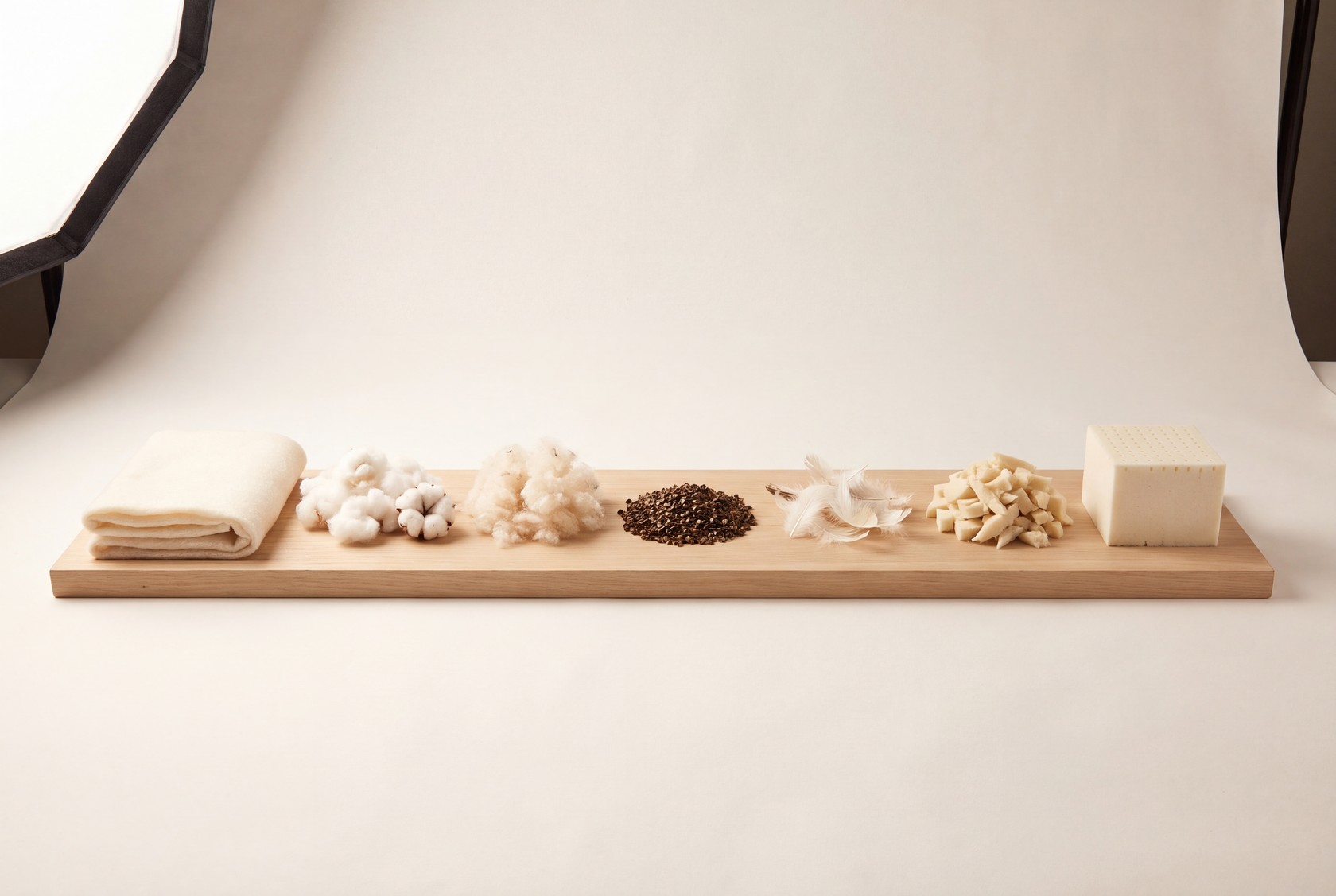
Pillows are stuffed with animal fibers, plant materials or synthetics, sold as loose fill, layered batting or a solid block.
Every pillow is a fabric shell around a filling, and the filling decides most of what you feel. Sellers use dozens of trade names, but you can sort the materials by where they come from: animal fills, plant fills that are grown and then cleaned or processed, and synthetics made in a factory.
Origin is only half the picture, because one material can reach you in several forms, and form changes the feel as much as the material does. Fibers can be packed loose, laid in as layered batting, or blended with something else. Latex and memory foam come either as one molded block or as a bag of shredded pieces. Buckwheat hulls are always loose, which is why those pillows pour rather than squash.
An unfamiliar name on a product page almost always belongs in one row of the table below, which ranks none of them.
| Stuffing | Family | What it is | Forms sold in pillows |
|---|---|---|---|
| Down | Animal | Soft clusters under a duck's or goose's outer feathers | Loose, often blended with feathers |
| Feathers | Animal | Outer plumage, quill included | Loose, usually blended with down |
| Wool | Animal | Washed, carded sheep's fleece | Batting or small balls |
| Cotton | Plant | Fiber grown on the cotton seed | Layered batting or loose tufts |
| Kapok | Plant | Fiber from kapok tree seed pods | Loose fiber |
| Buckwheat hulls | Plant | Shells of buckwheat seeds | Loose hulls |
| Natural latex | Plant | Foam made from rubber tree sap | Block or shredded |
| Polyester fiberfill | Synthetic | Fine plastic fibers sold as "down alternative" | Loose clusters or batting |
| Memory foam | Synthetic | Slow-recovery polyurethane foam | Block or shredded |
Where does cotton fit among the types of pillow stuffing?
Cotton is a plant fiber. Among pillow stuffings it sits with kapok and wool as a fiber fill, far lighter than buckwheat hulls.
Cotton is the soft fiber that grows around the seeds of the cotton plant, and it is cleaned and carded before it goes into a pillow. A textile reference describes the fiber as almost pure cellulose (Textile Learner). In other words, a cotton pillow's fill is close to a single plant material, with very little else in it.
By family, cotton sits with kapok as a plant fiber. By behavior, it sits with every fiber fill, including down, wool and polyester. Fiber fills hold air between their strands. Over a night your head presses that air out, and when you fluff the pillow some of it goes back in. That is what separates fiber fills from hulls, which shift and lock together, and from foams, which spring back on their own.
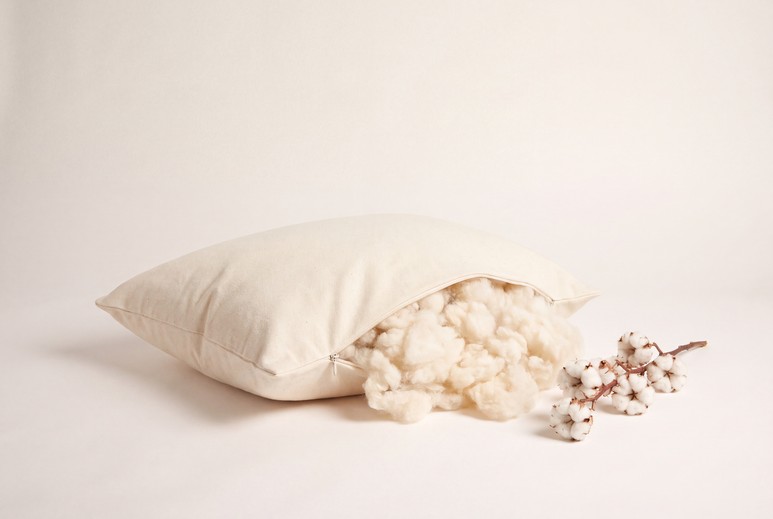
So where does cotton land inside the fiber group? One seller that makes cotton, wool and kapok pillows calls its cotton version a little firmer and thicker than the other two (Natural Linens). Cotton comes in two main forms: loose fill torn into tufts, and layered batting, where carded cotton is laid down a layer at a time and some layers stay joined at a fold. Our hub on what cotton fill is covers the material itself, and the guide to what is inside an organic cotton pillow covers the forms in more detail.
What do cotton pillow listings say about the stuffing inside?
Of 5 cotton pillow pages we read, 3 gave a fill weight, 1 gave a weight without saying what it covers, and 1 gave no weight at all.
Our count: On October 18, 2026 we read 5 US seller product pages for pillows sold with cotton fill, and sorted what each one said about weight into three groups. The count comes from the words on each page, so it records what sellers state rather than what sits inside their pillows.
- States a fill weight (3 pages): Healthier Homes lists its standard pillow at a medium fill weight of 19 oz and a firm fill weight of 27 oz (Healthier Homes). Natural Linens says the standard size is filled with 2 pounds of cotton (Natural Linens). Cece's Wool says each pillow is filled with at least two pounds of cotton batting (Cece's Wool).
- States a weight without saying what it covers (1 page): Cottoned lists a weight of a little over four pounds (2 kg) (Cottoned).
- Names the cotton fill but states no weight (1 page): Vermont Country Store says its fill is all cotton (Vermont Country Store).
The lesson is narrow. A weight with no word "fill" next to it may include the shell, so two listed numbers can be measuring different things.
Organic labels raise a second question. When a finished pillow is sold as certified organic, the certificate may cover the whole pillow or only its cover, and the listing does not always say which. Our guide on whether a GOTS label covers the fill answers that question.
Which pillow fillings come from animals?
Down, feathers and wool come from animals. Under US labeling standards, a pillow sold as down must be at least 75% down cluster.
Three animal fills turn up in pillows: down, feathers and wool. Down is the soft cluster that grows under a duck's or goose's outer feathers, and it has no hard quill. Feathers are the outer plumage, quill and all, and they give a blend its body. Wool is sheep's fleece, washed and carded into batting or rolled into small balls.
Down is the only animal fill with an exact US naming rule. Under the American Down and Feather Council's standard, a product labeled "Down" must contain a minimum of 75% down cluster, and the percentage of down must be listed on the label (ADFC). That standard also lets a maker name the species, such as goose, only when nearly all of the plumage comes from that bird, so a "goose down" name tells you about the bird as well as the cluster count.
State bedding laws add a second layer. Connecticut's consumer protection office says the law label explains exactly what the hidden filling material is, with the percentage of each material if more than one is used (Connecticut DCP). It also says feather and down must have gone through a sterilization process. If you want to know what an animal-filled pillow holds, the sewn-in law label tells you more than the product title.
Which pillow fillings come from plants?
Cotton, kapok, buckwheat hulls and natural latex come from plants: a seed fiber, a seed pod fiber, a seed shell and a tree sap.
Four plant materials are common in pillows, and each comes from a different part of the plant. Cotton is the fiber that grows on the seed, as covered above. Kapok is a fiber from the seed pods of the kapok tree. It is silky and light, and it does not handle water well. One seller tells buyers not to wash loose-fill pillows because they will clump, and kapok fiber is very hard to dry once soaked (Soaring Heart).
Buckwheat hulls are the hard outer shells of the buckwheat seed. You may have searched for buckwheat "husks"; this page uses hulls, the word sellers print. One seller explains that the outer shell, called the hull, is cleaned, dried, sometimes heat-treated to remove dust, and used as a natural pillow filling (Turmerry). Hulls are not a fiber at all. They pour, shift and lock into whatever shape you press into them.
Natural latex is a foam made from the sap of the rubber tree. The sap is whipped and cured into a block, which can then be chopped into shreds. It is plant-derived, but it goes through far more processing than the other three.
Of the four, cotton and kapok are fibers that compress under your head. Hulls and latex hold their own shape, each in a different way. That split will tell you more than the word "natural", which covers all four.
Which pillow fillings are made from synthetic materials?
Polyester fiberfill, memory foam and shredded foam are made in factories from petroleum-based polymers rather than grown on a farm.
Synthetic fills are made, not grown. The most familiar is polyester fiberfill, fine plastic fibers that sellers often market as "down alternative". That name describes a feel rather than an ingredient, and the fill contains no down. Polyester can be blown in as loose clusters or laid in as batting, which puts it in the fiber group alongside cotton, even though it comes from the opposite kind of source.
Memory foam is the other major synthetic. NASA's Spinoff publication says memory foam was invented for a 1960s Ames Research Center project to improve airline seating safety (NASA Spinoff). A 2005 Spinoff article dates the material to 1966 and says it was first called slow spring back foam, because it flowed to match the contour of the body pressing against it and returned to its original shape once the pressure was removed (NASA Spinoff). That slow return is the feel of a memory foam pillow today.
Foam comes as one molded block or as shredded pieces. A block holds a fixed shape. Shredded foam is loose, so you can open a zipper and take some out, as you would with cotton or hulls. Some pillows mix families: one seller describes its fill as a mix of shredded open cell memory foam and super soft kapok fibers (Layla). If you buy a mixed pillow, expect it to behave partly like each of its ingredients.
How much does each pillow filling weigh in a standard pillow?
A cotton pillow stays light enough for you to lift and reshape by hand: sellers list about 2 pounds of cotton, while hull pillows near 10 pounds.
Weight tells you how a pillow will handle when you pick it up, plump it or carry it to the wash. It separates the families more clearly than any adjective does. The table collects what seller pages state for a standard pillow, and it says whether each figure covers the fill or whether the page leaves that open.
| Stuffing | What the page states | Weight covers | Source |
|---|---|---|---|
| Cotton | 19 oz medium, 27 oz firm | Fill | Healthier Homes |
| Cotton | 2 lb | Fill | Natural Linens |
| Kapok | About 26 oz | Not stated | Soaring Heart |
| Buckwheat hulls | 9 lb 12 oz | Not stated | Hullo |
| Memory foam, latex | No standard-size weight found in the pages we read | Not applicable | None |
Read the table for scale, not as exact specifications. Fiber fills stay at a few pounds or less because a fiber is mostly air, while buckwheat hulls weigh several times more in a case of matching size, because each hull is a solid shell. For you, that means a cotton or kapok pillow can be lifted and plumped with one hand, while a hull pillow takes more effort to move around the bed.
Within one material, the spread mostly reflects firmness, since more fill gives you a firmer, taller pillow. When you compare two cotton pillows by weight, first make sure both numbers describe the fill.
How do the types of pillow stuffing differ once your head is on them?
Fibers compress and can be fluffed, hulls shift and lock, and foam springs back. Cotton belongs to the fibers that pack down.
The families differ most clearly under the weight of your head. Fiber fills compress: your head pushes the air out from between the strands, and fluffing or airing puts some of it back. Hulls barely compress, because they slide aside and then interlock. Foams compress and return on their own, latex quickly and memory foam slowly.
The table below is an editorial judgement, drawn from the mechanics described above rather than from any seller's claims, and it ranks nothing.
| Family | What holds the shape | What changes with use | Can you set the height by removing fill? |
|---|---|---|---|
| Fiber fills (cotton, kapok, wool, down, polyester) | Air trapped between fibers | Fibers pack down; fluffing restores part of the height | Yes, if the shell has a zipper |
| Hulls (buckwheat) | Hulls locking against each other | Hulls wear and settle | Yes, by pouring hulls out |
| Solid foam (latex, memory foam) | The foam's own spring | The block softens | No |
| Shredded foam | Foam pieces pressing against each other | Pieces settle and can be moved around | Yes, if the shell has a zipper |
Research has compared pillow types mostly in terms of neck pain. A systematic review and meta-analysis in Clinical Biomechanics found spring and rubber pillows effective in reducing neck pain for people with chronic neck pain (PolyU Scholars Hub). Rubber here means latex, and the finding says nothing about cotton or any other fill, so this page does not stretch it into a verdict. What it does show you is that researchers also group pillows by material.
Common questions
Is down alternative the same as down?
No. "Down alternative" is a sales name for synthetic fill, usually polyester fiberfill, chosen to suggest the softness of down, and you will find no down inside it. A pillow labeled down must meet the industry minimum for down cluster (ADFC).
Does the tag have to list what a pillow is stuffed with?
Yes, that is the job of the law label. Connecticut requires pillows and similar products with hidden filling to carry one, and the label explains exactly what the hidden filling material is (Connecticut DCP). If you cannot find the tag, ask the seller before you assume what is inside.
Does "organic" on a pillow mean the stuffing is organic?
Not always. A certification belongs to a finished product, and on a pillow that product may be the cover alone, with the fill left out. Read the fill line on the law label, not just the product name, to see what you are getting.
Is kapok a type of cotton?
No. Kapok grows in the seed pods of the kapok tree, which is a different plant from cotton. Both are soft plant fibers, so you often see them side by side. One seller describes its kapok as having a silky, feather-like feel (Sachi Organics).
Can one pillow contain more than one stuffing?
Yes. Down and feather blends are the oldest example, and the down standard requires the minimum down content to be listed when a product holds both (ADFC). Newer pillows mix families, such as shredded foam with kapok, and the law label should list every filling.
Which pillow stuffing is the heaviest?
Buckwheat hulls, among the pages we read. One seller's standard buckwheat pillow (Hullo) weighs several times as much as the cotton another seller lists for its standard pillow (Natural Linens).
Sources
The cotton spec sheet's outside references, one line apiece, tagged with the section that cites them.
- Natural Linens (naturallinens.com), cited under “Where does cotton fit among the types of pillow stuffing?”; “What do cotton pillow listings say about the stuffing inside?”; “How much does each pillow filling weigh in a standard pillow?”; “Common questions”.
- Hullo (hullopillow.com), cited under “How much does each pillow filling weigh in a standard pillow?”; “Common questions”.
- Textile Learner (textilelearner.net), cited under “Key Takeaways”; “Where does cotton fit among the types of pillow stuffing?”.
- Healthier Homes (healthierhomes.com), cited under “What do cotton pillow listings say about the stuffing inside?”; “How much does each pillow filling weigh in a standard pillow?”.
- Cece's Wool (ceceswool.com), cited under “What do cotton pillow listings say about the stuffing inside?”.
- Cottoned (cottonedshop.com), cited under “What do cotton pillow listings say about the stuffing inside?”.
- Vermont Country Store (vermontcountrystore.com), cited under “What do cotton pillow listings say about the stuffing inside?”.
- ADFC (downandfeathercouncil.com), cited under “Which pillow fillings come from animals?”; “Common questions”.
- Connecticut DCP (portal.ct.gov), cited under “Which pillow fillings come from animals?”; “Common questions”.
- Soaring Heart (soaringheart.com), cited under “Which pillow fillings come from plants?”; “How much does each pillow filling weigh in a standard pillow?”.
- Turmerry (turmerry.com), cited under “Which pillow fillings come from plants?”.
- NASA Spinoff (spinoff.nasa.gov), cited under “Which pillow fillings are made from synthetic materials?”.
- NASA Spinoff (spinoff.nasa.gov), cited under “Which pillow fillings are made from synthetic materials?”.
- Layla (laylasleep.com), cited under “Which pillow fillings are made from synthetic materials?”.
- PolyU Scholars Hub (research.polyu.edu.hk), cited under “How do the types of pillow stuffing differ once your head is on them?”.
- Sachi Organics (sachiorganics.com), cited under “Common questions”.